
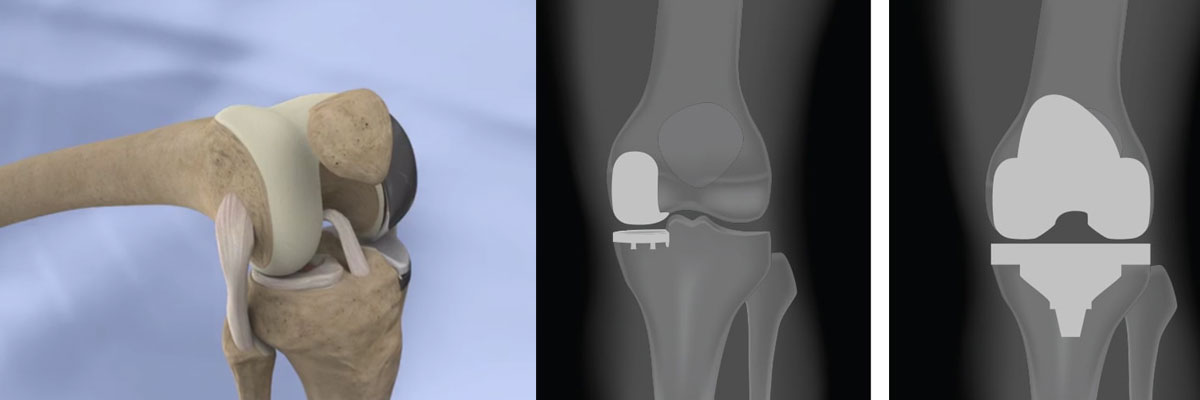
Total knee replacement (arthroplasty) has proven to be a very effective surgical treatment of osteoarthritis of the knee for many years. Relatively recently, however, partial knee replacement (also known as unicondylar knee replacement) has emerged as a possible – and viable – option for certain patients.
Figure: Medial compartment osteoarthritis
Overview of surgery
The knee is made up of three compartments: the medial compartment (located on the inside of the knee), the lateral compartment (located on the outside of the knee), and the patellofemoral compartment (located in the front of the knee). In a particular group of osteoarthritis patients, however, the entire knee is not affected by the arthritis. In some patients, only the medial compartment (or, less commonly, only the lateral compartment) may be affected by the disease. For those patients, unicondylar (partial) knee replacement can be considered a treatment option. The term “unicondylar” refers to the replacement of only one section of the smooth bone ends (condyles) – the medial or lateral compartment – as compared to total knee replacement, which involves replacement of all three compartments.
Figure: Medial compartment spontaneous osteonecrosis in a 74-year-old woman
The concept of unicondylar knee replacement entails replacement of the diseased medial or lateral compartment and preservation of the anterior (front) and posterior (rear) cruciate ligaments. In contrast, a standard, posterior stabilized total knee replacement requires the removal of both the anterior and posterior cruciate ligaments, and the implant substitutes for these ligaments.
Since only a part of the joint is replaced in a unicondylar procedure, the surgery often can be performed through a smaller incision and involves less bone and soft tissue dissection, thereby offering potential benefits in the early rehabilitation period. Most studies have shown that a unicondylar knee replacement results in less blood loss and a lower incidence of medical complication. Patients undergoing a unicondylar knee replacement also seem to have a more favorable outcome in regard to certain functions like stair climbing or kneeling. Most studies suggest that patients with a successful unicondylar knee replacement recover range of motion faster and have better overall range of motion compared to patients undergoing total knee replacement.
Figure: A valgus stress view shows an intact lateral compartment in a good candidate for a unicondylar knee replacement
The revision rate is higher for unicompartimental knee replacements than for total knee replacement. Based on most studies, a revision of a unicondylar knee replacement will not result in the same functional outcome as in patients that undergo a total knee replacement as their primary procedure. In addition, the revision surgery at times is technically more complex than a primary total knee replacement, especially when bone loss and decreased range of motion are encountered.
The Development of Unicondylar Knee Replacement
The early results of unicondylar knee replacement in the United States in the 1970s and 1980s were discouraging. The first papers reporting the outcome of uni-implants designed in the 1970s often showed a failure rate in the range of 40% at ten years, far below the consistently good results of total knee arthroplasty. Therefore, unicondylar knee arthroplasties never gained popularity in the United States.
Improvements in design have led to the next generation of unicondylar knee replacement implants, which offer better results in selected patients.
In 1998, Dr. Richard Scott and Stuart Kozinn published criteria for the selection of patients for unicondylar knee replacement. At the time, their criteria reflected a selection of patients that would provide a lasting result with a unicondylar knee replacement. Scott and Kozinn considered patients older than 60 years of age suitable candidates because, when compared to younger patients undergoing traditional knee replacement, they typically engage in a diminished level of activity after surgery. Patients with systemic inflammatory arthritis, such as rheumatoid arthritis, were also not considered candidates for this procedure.
In our experience the patient on both extremes of age are good candidates for UKA provided they satisfy other criteria.
In addition to these criteria, patients with a relatively good preoperative range of motion and a minimal amount of deformity were considered to be ideal candidates for a unicondylar knee replacement.
Steps of Surgery
Implant Designs
Today, there are two different concepts for partial knee replacement available for patients in the United States.
A fixed bearing knee replacement is a knee arthroplasty where the tibial (lower leg) plastic insert is fixed to the tibial bone and does not allow movement of the bearing surface. Most implants today fall into this category.
Figure: Example of a fixed bearing unicondylar knee replacement
The concept of the mobile bearing knee arthroplasty is to have a fixed metal component on the tibial (lower leg) as well as the femoral (upper leg) side and then have a mobile plastic insert which allows for a mobile articulation (low-friction contact). The theoretical benefit of a mobile bearing knee arthroplasty is a greater contact surface between the plastic insert and the metal component of the knee arthroplasty. Larger contact surfaces have proven to reduce the amount of linear wear in the knee arthroplasty.
Figure: Mobile bearing unicondylar knee replacement
Patients can be considered a candidate for a unicondylar knee replacement if they:
Figure: Example of a unicondylar knee replacement
(the images on top represent a preoperative joint; the images on the bottom represent a postoperative joint)
Results
The mobile bearing unicondylar knee arthroplasty, if performed by well-trained surgeons performing high numbers of these surgeries annually, has shown survival rates at ten years of up to 95% at specialized centers.
The survival rate of the mobile bearing knee replacement in younger patients has also been relatively high. In a recent study comparing younger and older patients, the overall survival rate for patients under 60 years of age has been 91%, compared to 96% in patients older than 60 years of age.
In heavier and older patients with evidence of patellofemoral arthritis, the results have been better with the mobile bearing knee arthroplasty than with other unicondylar knee designs
Complications
Unicondylar knee arthroplasty is a surgery that could result in complications during and after the procedure. This type of surgery shares the same possible postsurgical complications as total knee replacements, which include:
Care ful patient selection, good pre op planning and precise surgical technique results in a happy patient of UKA or Half Knee replacement.